Uncategorized Archives - Page 4 of 14 - QHStaff

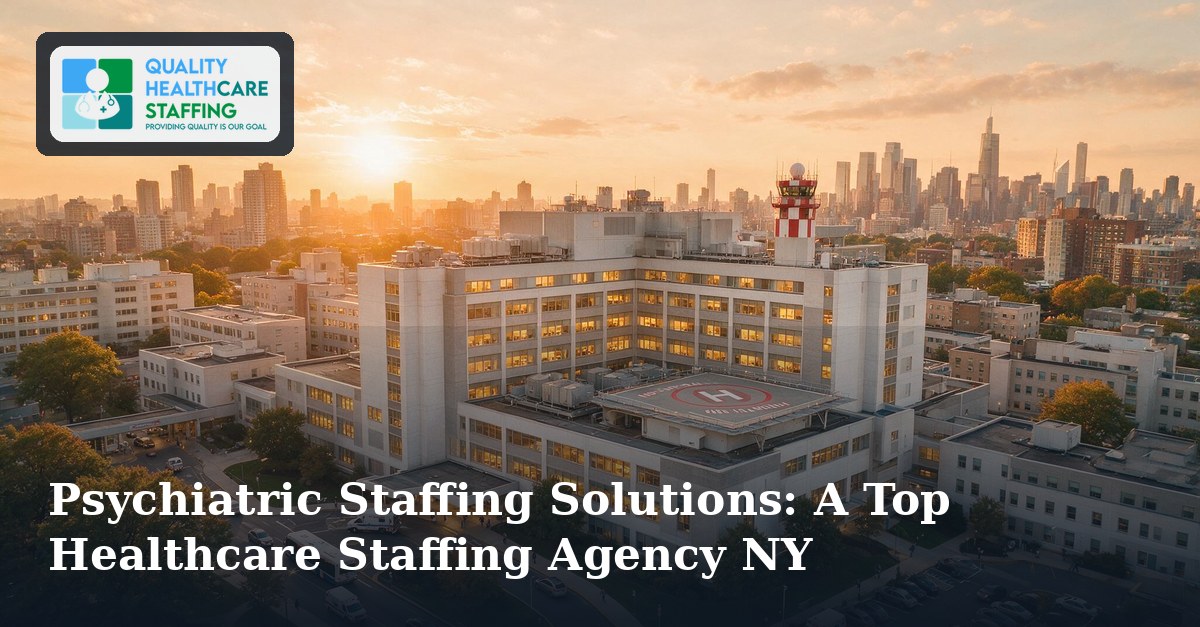
Psychiatric Staffing Solutions: A Top Healthcare Staffing Agency NY

The demand for high-quality behavioral health services has never been more critical, especially across New York. Healthcare facilities are continuously challenged to find and retain specialized staff who can provide compassionate, expert care to patients facing complex mental and behavioral health conditions. At Quality Healthcare Staffing (QHS), we understand these unique pressures. As a premier healthcare staffing agency NY, we bridge the gap between healthcare organizations needing specialized talent and skilled professionals seeking impactful career opportunities. This post explores the vital role of psychiatric and behavioral health staffing and how QHS serves both our client facilities and our dedicated healthcare professionals.

The Evolving Landscape of Behavioral Health in NY

New York’s healthcare system is experiencing an unprecedented surge in the need for mental and behavioral health services. Factors such as increased awareness, the lingering effects of global health crises, and an aging population contribute to a growing demand for specialized care. This surge places significant strain on hospitals, clinics, and long-term care facilities, leading to staffing shortages and increased burnout among existing teams.

Addressing these challenges requires a strategic approach to recruitment and retention. Facilities need partners who deeply understand the nuances of behavioral health, from specific patient needs to the qualifications required for effective intervention. For professionals, this landscape presents a wealth of opportunities to contribute their expertise in diverse settings, making a tangible difference in the lives of vulnerable populations.

Specialized Staffing for Complex Needs

Psychiatric and behavioral health roles demand a unique blend of clinical expertise, empathy, and specialized training. QHS recognizes that not all healthcare professionals are equipped for these sensitive environments. We meticulously vet candidates for positions such as Psychiatric Registered Nurses (RNs), Licensed Practical Nurses (LPNs), Certified Nursing Assistants (CNAs) specializing in behavioral health, social workers, and therapists.

Our rigorous screening process goes beyond basic certifications. We assess candidates for critical skills including crisis intervention, therapeutic communication, de-escalation techniques, and a profound understanding of psychiatric medication management. This ensures that every professional we place is not only qualified but also possesses the temperament and experience necessary to thrive in challenging behavioral health settings. This content is for informational purposes only and is not medical advice.

Benefits for Healthcare Facilities in NY

Partnering with a specialized healthcare staffing agency like QHS offers significant advantages for facilities grappling with staffing shortages in New York. We provide rapid access to a pre-qualified pool of professionals, enabling facilities to quickly fill critical vacancies without the lengthy and resource-intensive process of traditional recruitment. This reduces administrative burden and allows internal HR teams to focus on other strategic initiatives.

Our flexible staffing solutions, including per diem, contract, and direct-hire options, allow facilities to adapt to fluctuating patient loads and staffing needs. By leveraging QHS, healthcare organizations can maintain optimal staffing levels, reduce staff burnout, and ultimately enhance the quality of patient care. We act as a strategic partner, helping facilities across NY maintain operational continuity and deliver essential behavioral health services.

Career Opportunities for Behavioral Health Professionals

For nurses and other healthcare professionals specializing in psychiatric and behavioral health, QHS unlocks a wide array of career opportunities. Whether you’re a seasoned Psychiatric RN looking for a new challenge in a major medical center, an LPN seeking flexible shifts, or searching for CNA jobs Brooklyn, we connect you with roles that match your skills and career aspirations. Our extensive network includes top healthcare providers across New York City and beyond.

We understand that professionals seek more than just a job; they seek meaningful work, competitive compensation, and opportunities for growth. QHS offers access to diverse clinical environments, allowing professionals to broaden their experience and develop new skills. We support our candidates throughout their placement, ensuring a supportive and rewarding professional journey.

Why Choose a Specialized Healthcare Staffing Agency NY?

Choosing a specialized healthcare staffing agency NY like QHS means partnering with experts who understand the unique demands of the behavioral health sector. We are deeply familiar with New York’s regulatory landscape and the specific needs of its diverse patient populations. Our focus on psychiatric and behavioral health staffing allows us to cultivate a talent pool specifically tailored to these critical roles.

Our commitment to quality ensures that both our client facilities and our placed professionals benefit from a seamless and effective partnership. We pride ourselves on our ability to precisely match the right talent with the right opportunity, contributing to better patient outcomes and professional satisfaction across the state. Trust QHS to be your reliable partner in navigating the complexities of behavioral health staffing.

Frequently Asked Questions

How does QHS ensure the quality of psychiatric staff?

QHS employs a rigorous multi-step vetting process. This includes in-depth interviews, comprehensive background checks, license verification, skills assessments tailored to behavioral health, and reference checks. We ensure all professionals meet or exceed industry standards and possess the specific competencies required for psychiatric care.

What types of behavioral health roles are most in demand in NYC?

In NYC, there is consistently high demand for Psychiatric Registered Nurses (RNs), Licensed Practical Nurses (LPNs) with behavioral health experience, and Certified Nursing Assistants (CNAs) for roles in psychiatric units, crisis stabilization centers, and long-term behavioral health facilities. We also frequently staff for social workers and therapists. If you are looking for nurse staffing agency NYC or CNA jobs Brooklyn, we have opportunities.

Can QHS help with both short-term and long-term staffing needs?

Yes, QHS offers flexible staffing solutions designed to meet a wide range of needs. Whether your facility requires per diem staff to cover immediate shifts, contract professionals for extended periods, or direct-hire candidates for permanent positions, we can tailor our services to provide the optimal staffing solution for your organization.

The need for skilled behavioral health professionals is undeniable, and Quality Healthcare Staffing stands ready to meet this demand. We are dedicated to supporting New York’s healthcare facilities with exceptional talent and empowering healthcare professionals to find rewarding careers in this vital field. Discover how QHS can be your strategic partner in psychiatric and behavioral health staffing. Request staff — https://qhstaff.com/contact/.
10 Questions to Ask Before You Sign With a Staffing Agency

Signing with a staffing agency often happens under time pressure — a facility is short-staffed, a vacancy needs filling now, and the decision gets made quickly based on who responds fastest. That’s understandable, but it’s also how facilities end up in year-long contracts with partners who don’t actually serve them well. A short list of direct questions, asked before you sign, surfaces most of what actually matters.

1. How Do You Vet Clinical Candidates?

Ask specifically what the credentialing process looks like — license verification, background checks, reference checks, and how recently those checks are refreshed for staff who work with you regularly. An agency that gives a vague answer here is telling you something important.

2. What Happens When a Shift Falls Through at the Last Minute?

Every staffing relationship eventually hits a no-show or last-minute cancellation. The real question is what the agency’s process is when that happens — is there a backup plan, a point of contact who’s actually reachable, or are you on your own to scramble?

3. How Familiar Is Your Candidate Pool With Facilities Like Mine?

An agency that primarily places hospital staff may not have deep experience with the specific rhythms of skilled nursing, behavioral health, or long-term care. Ask directly about their experience in your specific setting, not just healthcare broadly.

4. Who Is My Actual Point of Contact, and What Are Their Hours?

Vague answers here (“our team is always available”) are a warning sign. You want a name, a direct line, and clarity about coverage during nights and weekends if that’s when you’re most likely to need help.

5. How Do You Handle a Poor Fit?

Sometimes a placed candidate isn’t the right fit for your unit, through no fault of anyone. Ask what the process is for addressing that quickly and professionally, without it becoming a drawn-out ordeal for your director of nursing.

6. What’s Your Typical Time-to-Fill for a Role Like Mine?

Ask for a realistic answer based on your specific role and location, not a generic marketing number. A good partner will tell you honestly when a specific specialty or shift is harder to fill.

7. Are There Long-Term Contract Terms I Should Understand Clearly?

Read the actual terms around exclusivity, minimum commitments, and cancellation before you sign — not after a problem arises. A transparent partner will walk you through this without pressure.

8. How Do You Communicate During a Seasonal Surge?

Ask how the agency plans ahead for predictable surges like flu season, rather than treating every surge as a surprise. Their answer tells you whether they think proactively about your facility or only react to your calls.

9. Can You Provide References From Facilities Similar to Mine?

A confident agency will connect you with current clients in similar settings. Hesitation here is worth noting.

10. What Does Onboarding Look Like for a New Placement?

Ask specifically how a placed nurse or CNA gets oriented to your EMR, your unit’s specific protocols, and your team — not just whether they show up credentialed and licensed.

Why This Matters More Than It Seems

None of these questions are complicated, but very few facilities ask all ten before signing. The agencies worth partnering with will welcome the questions rather than deflect them, because confident, transparent answers are exactly what a good long-term relationship is built on.

QH Staffing is happy to answer every one of these questions directly, with specifics rather than marketing language. Schedule a conversation with our team, or call (718) 400-6166, and ask us anything on this list.

Book a meeting with our team — pick a time that works for you.

Nassau County Nurse Staffing: What Long Island Facilities Need to Know

Nassau County’s healthcare staffing market runs on a different logic than the five boroughs, and facility administrators who apply NYC-based assumptions here often end up frustrated by results that don’t match their expectations. Understanding the specific shape of the Nassau market — commute patterns, candidate expectations, and where the local talent pipeline actually comes from — makes the difference between a staffing plan that works and one that quietly underperforms for months.

Commuting Works Differently on Long Island

In much of NYC, subway access defines whether a candidate can realistically reach a facility. In Nassau County, the equation is almost entirely car-dependent, which changes both who applies and what “reasonable commute” means. A candidate willing to drive 25 minutes down the Meadowbrook or Wantagh Parkway is a very different applicant pool than someone relying on LIRR access into a specific station town. Facilities near LIRR stops do draw some candidates commuting out from Queens or Brooklyn, but the core of most Nassau facilities’ workforce lives locally and drives.

This means job postings that specify parking availability and realistic drive-time radius tend to perform better than generic postings, since candidates are mentally mapping their actual commute, not a transit line.

A Suburban Candidate Pool With Different Priorities

Nassau County’s nursing and CNA workforce often includes a higher proportion of staff balancing family logistics — school pickup schedules, suburban household demands — that shape which shifts and scheduling arrangements actually attract applicants. Facilities that build genuine flexibility into part-time and per diem scheduling options often see stronger response rates than those offering only rigid full-time shifts, simply because it matches how a meaningful share of the local workforce needs to structure their week.

Local Training Pipelines Worth Building Relationships With

Nassau Community College’s nursing program, along with several CNA and LPN certificate programs across the county, produce a steady pipeline of new clinicians who often prefer to stay local rather than commute into the city. Facilities that build clinical rotation partnerships and mentorship relationships with these programs create a direct path from student to hire — one that’s considerably more efficient than competing for experienced hires against every other facility in the county through general job postings alone.

What Sets Successful Nassau County Facilities Apart

  • They post shifts with realistic drive-time and parking information rather than assuming candidates think in transit terms
  • They build flexible scheduling options that accommodate the suburban, family-logistics-driven workforce common in the county
  • They maintain active relationships with Nassau-based nursing and CNA training programs rather than relying solely on general postings
  • They work with staffing partners who have real Nassau County placement history, not just NYC-focused networks stretched to cover Long Island as an afterthought
  • They recognize seasonal patterns specific to the county — summer vacation coverage gaps can hit differently here than in denser urban markets

Building a Nassau-Specific Staffing Strategy

Facilities that treat Nassau County staffing as simply “NYC staffing, but further out” tend to underperform their own expectations. The market rewards a genuinely local approach — understanding how candidates commute, what scheduling flexibility they need, and where the county’s own training pipelines actually are.

This distinction matters most during a search that’s dragging longer than expected. A facility that keeps posting the same generic listing without adjusting for local commute realities or scheduling preferences often assumes the market itself is simply tight, when the more fixable issue is that the posting isn’t speaking to how Nassau County candidates actually evaluate an opportunity.

QH Staffing maintains active placement relationships across Nassau County and understands how the market here differs from the boroughs. Reach out through our Nassau staffing page or call (718) 400-6166 to talk about coverage for your facility.

Book a meeting with our team — pick a time that works for you.

The Bronx Staffing Landscape: Challenges and Opportunities for Facility Leaders

The Bronx has long carried a reputation, not entirely undeserved, as one of the more staffing-challenged healthcare markets in the region. Facility administrators here often describe longer time-to-fill for open positions and more competition for experienced clinical staff than colleagues in other boroughs report. Understanding why that gap exists — and what actually closes it — matters more than repeating the reputation as an excuse.

Why the Bronx Faces Real Staffing Pressure

Several factors compound in the Bronx in ways that don’t always show up as clearly elsewhere. The borough has a higher concentration of Medicaid-reliant facilities, which historically has meant tighter operating margins and less room for the kind of aggressive recruiting incentives that better-resourced facilities elsewhere can offer. At the same time, the Bronx’s resident population often presents with higher acuity and more complex social needs, which raises the bar for what “adequately staffed” actually requires clinically, not just numerically.

None of this means the Bronx is an impossible market — it means it’s a market where staffing strategy has to be more deliberate, because the margin for error is thinner.

The Opportunity Side: A Committed, Local Workforce

What often gets lost in conversations about Bronx staffing challenges is the strength of the borough’s home-grown healthcare workforce. Bronx-based nursing and CNA training programs, including strong pipelines through Lehman College, Monroe College, and several CNA certificate programs, produce clinicians who frequently want to work close to home and are deeply invested in serving their own community. Facilities that build real relationships with these local training pipelines — offering clinical rotations, mentorship, and a genuine path to hire — often find a level of staff loyalty and community connection that’s harder to replicate with staff commuting in from outside the borough.

What Distinguishes Facilities That Staff Well in the Bronx

The facilities that manage staffing successfully in the Bronx tend to share a few practices in common:

  • They build direct relationships with local training programs rather than relying only on general job postings
  • They work with staffing partners who have genuine, sustained Bronx placement experience — not agencies treating the borough as an afterthought to Manhattan or Brooklyn business
  • They invest visibly in newer staff, since retention in a tight market starts with how someone is treated in their first ninety days
  • They’re realistic and proactive about lead time for open positions, starting the search earlier rather than waiting until a vacancy becomes urgent
  • They recognize that competitive, predictable scheduling can matter as much as pay in a market where staff have real, if imperfect, alternatives

Building a Sustainable Bronx Staffing Strategy

The facilities that struggle most in the Bronx are usually the ones treating every open position as a fire to put out individually, rather than building a standing pipeline that reduces how often the fire starts in the first place. A staffing partner who already has an active Bronx candidate network — nurses and CNAs who’ve worked in the borough, understand its patient population, and want to stay local — can shorten fill times meaningfully compared to starting a search from zero each time.

This also means facility leaders should resist the temptation to treat every open Bronx role identically to how it would be staffed elsewhere in the region. A staffing approach built specifically around the borough’s realities — its training pipelines, its patient acuity, its Medicaid-heavy payer mix — consistently outperforms a generic, one-size-fits-all approach imported from a different market.

QH Staffing maintains an active Bronx placement network built through years of working directly with facilities and training programs across the borough. If your facility is fighting the same time-to-fill challenges every quarter, we can help you build something more durable. Reach out through our Bronx staffing page or call (718) 400-6166.

Book a meeting with our team — pick a time that works for you.

Part-Time Cardiology Consulting in Brooklyn: What It Actually Looks Like

Most part-time physician opportunities get described in two ways: vague (“competitive compensation, flexible schedule, exciting opportunity”) or suspicious-sounding, which is why so many board-certified cardiologists scroll past them without a second look. There’s a real gap between those two extremes, and it’s worth describing plainly.

The Basic Shape of the Arrangement

A part-time cardiology consulting role at a New York State facility typically works like this: a fixed number of hours per week, scheduled in one block rather than scattered across the calendar, with no on-call rotation and no nights or weekends attached. It’s structured as 1099 contractor work rather than W-2 employment, which means no tax withholding from each payment — the tradeoff most physicians already understand from per diem or locum work, in exchange for scheduling flexibility and access to business-expense deductions a W-2 role doesn’t offer.

The part that matters most to the physicians actually considering this kind of work: it’s additive. You are not resigning from anything to take it. It sits on top of an existing hospital position, private practice, or retirement, not in place of it.

Who Actually Takes These Roles

Three groups tend to be the best fit, for different reasons:

  • Established attendings who want supplemental income without adding call to an already full week.
  • Retired or semi-retired cardiologists who still hold an active New York license and want to stay clinically engaged on a lighter schedule — often the least-targeted group in traditional physician recruiting, and frequently the best fit for exactly this kind of arrangement.
  • Fellows finishing training who want a state-contract credential that fits around a hospital schedule.

Why the Setting Matters

Roles like this often sit inside New York State agency facilities serving patients with serious mental illness — a population with documented, substantially elevated cardiovascular risk. A 2017 meta-analysis published via the National Institutes of Health found that patients with severe mental illness face a 53% higher risk of having cardiovascular disease, a 78% higher risk of developing it, and an 85% higher risk of dying from it compared to the general population, with cardiovascular disease recognized as the main treatable driver of early death in this group ([source](https://pmc.ncbi.nlm.nih.gov/articles/PMC5428179/)). A cardiologist adding a few hours a week to a facility serving this population is addressing a documented, specific gap — not a generic staffing shortage.

The Questions Worth Asking Before You Apply

Any legitimate part-time consulting arrangement should be able to answer, clearly and specifically, before you commit to anything:

  • Does this conflict with your existing hospital contract or exclusivity clause?
  • Who carries malpractice coverage for the work?
  • How long does credentialing actually take?
  • What does the 1099 structure mean for your taxes?
  • What does stepping away look like, if the arrangement isn’t the right fit?

If a recruiter can’t answer these on the first call — before asking you to sign anything — that’s worth treating as a signal.

Considering It in Brooklyn

Quality Healthcare Staffing is currently working with a New York State agency on a part-time cardiology consulting role based in Brooklyn. No call, no nights, no weekends, and a real person — not a call center — follows up after you apply.

Learn more or apply: [qhstaff.com/cardiologist](https://qhstaff.com/cardiologist/?utm_source=blog&utm_medium=organic&utm_campaign=cardio_c202802)

Queens Healthcare Staffing: Navigating a Diverse, High-Demand Market

Queens is often described as one of the most linguistically and culturally diverse places in the country, and that diversity shapes its healthcare staffing market in ways that are easy to underestimate from the outside. Facility administrators who treat Queens hiring the same way they’d approach a more homogeneous market tend to leave qualified candidates on the table simply because their search and screening process wasn’t built for the borough they’re actually operating in.

A Workforce That Speaks the Borough’s Languages

Queens residents speak well over a hundred languages combined, and its healthcare workforce reflects a meaningful slice of that range. For facilities serving Flushing, Jackson Heights, Elmhurst, or the Rockaways, matching staff language capability to resident and family communication needs isn’t a diversity checkbox — it’s a functional requirement that affects informed consent conversations, family updates during health changes, and basic resident comfort. A staffing partner with genuine Queens roots typically has candidate networks that reflect this range, which narrower or citywide-only agencies sometimes don’t.

Geographic Spread Changes the Commute Calculation

Queens is the largest borough by land area, and that spread matters enormously for staffing. A candidate living in Astoria may have a completely different realistic commute to a facility in Far Rockaway than to one in Long Island City, even though both are “in Queens.” Facilities near major transit hubs — the 7 train corridor, LIRR stations, or express bus routes — draw from a meaningfully larger radius than those in more transit-isolated pockets of the borough.

This means staffing timelines can vary significantly by exact location, even within the same borough. Administrators planning for open positions should factor in their specific transit access rather than assuming Queens-wide averages apply evenly.

Competition From Both Directions

Queens facilities compete for talent not only with each other, but with Manhattan and Brooklyn facilities that are a reasonable commute away for many Queens-based nursing staff. At the same time, Queens draws candidates who specifically prefer not to commute into Manhattan, giving borough facilities a real advantage if they lean into that preference in how they recruit and describe the role.

What Works for Facilities Hiring in Queens

  • Partner with a staffing agency that maintains an active, multilingual candidate network specific to Queens, not just a citywide pool
  • Be specific about transit access in job postings and shift requests — it directly affects who applies and how fast
  • Highlight, where genuinely true, that the role doesn’t require a Manhattan commute — this resonates with a real segment of the borough’s healthcare workforce
  • Understand that “Queens” staffing timelines vary meaningfully by neighborhood, and plan lead time accordingly
  • Build relationships with local nursing and CNA training programs based in the borough, which often place graduates who specifically want to stay close to home

Planning Around the Borough’s Scale

Because Queens spans such a wide geographic and cultural range, facility administrators benefit from being specific in every part of the hiring process rather than relying on general assumptions. That includes being upfront in interviews about the specific neighborhood, patient population, and language needs of the unit, rather than discovering a mismatch after a candidate has already accepted a role. It also means building enough lead time into hiring plans to account for the borough’s genuinely wide range of commute realities, rather than assuming every candidate search will move at the same pace.

Queens rewards facilities that understand its scale and diversity rather than treating it as a single, uniform market. QH Staffing has deep placement experience across Queens’ neighborhoods and understands how geography and language shape hiring here. Reach out through our Queens staffing page or call (718) 400-6166 to discuss coverage for your facility.

Book a meeting with our team — pick a time that works for you.

Staffing Brooklyn’s Skilled Nursing Facilities: What Makes This Borough Different

Brooklyn is not a single healthcare market — it’s a collection of very different neighborhoods, each with its own patient population, transit access, and competitive landscape for nursing talent. A facility in Brownsville is competing for staff under different conditions than one in Bay Ridge, even though both are technically “Brooklyn facilities.” Understanding that difference matters more than most facility leaders realize when they’re building a staffing strategy.

Density Cuts Both Ways

Brooklyn has one of the highest concentrations of skilled nursing and long-term care facilities of any borough in the region. That density means nursing talent has genuine choice — a CNA or LPN unhappy with scheduling, culture, or commute at one facility can often find a comparable opening within a short subway ride. That’s good for candidates and a real challenge for facilities that don’t actively work to be a place people want to stay.

The upside of that same density is a deep, if competitive, talent pool. Brooklyn’s healthcare workforce includes graduates from multiple nursing programs across the borough and citywide, plus a large population of experienced clinicians who specifically prefer to work close to home rather than commute into Manhattan. Facilities that position themselves well — manageable commutes, predictable scheduling, real support — can draw from that pool consistently.

Language and Cultural Fluency Matter Operationally

Brooklyn’s resident population is remarkably diverse, and that diversity has real staffing implications. Facilities serving neighborhoods with large Caribbean, Russian, Chinese, Orthodox Jewish, or Latino communities benefit meaningfully from staff who share language and cultural fluency with residents — not as a nice-to-have, but as something that affects care quality, family communication, and resident comfort during difficult transitions. Staffing partners with deep Brooklyn placement experience typically maintain networks that reflect this diversity, which matters when matching candidates to your specific resident population.

Transit Access Shapes Who Can Realistically Take a Shift

A facility near multiple subway lines has a fundamentally different applicant pool than one that’s a longer walk from transit, even if both are technically in Brooklyn. When facilities post open shifts, being explicit about transit access and, where relevant, parking availability helps attract candidates who might otherwise assume the commute isn’t workable. This is a small detail that staffing coordinators sometimes overlook, but it affects fill rates on short-notice shifts more than people expect.

What This Means for Building Your Staffing Strategy

Facility leaders in Brooklyn get the best results when they treat their staffing plan as neighborhood-specific rather than borough-generic:

  • Work with a staffing partner who understands the specific pocket of Brooklyn your facility sits in, not just “Brooklyn” as a category
  • Be explicit in shift postings about transit access, since it materially affects who applies
  • Prioritize candidates whose language and cultural background matches your resident population where possible
  • Recognize that Brooklyn nurses have real alternatives nearby, and build a workplace people choose to stay in rather than one they tolerate until something better opens up
  • Stay connected to nursing programs and community networks specific to your neighborhood, not just citywide job boards

Building Long-Term Relationships in a Borough With Options

Because Brooklyn nurses genuinely have alternatives nearby, the facilities that retain staff longest tend to be the ones that treat their nursing team as partners rather than interchangeable coverage. That means asking staff directly what would make their specific commute, shift pattern, or unit assignment work better, and actually acting on the answers rather than treating the conversation as a formality. It also means giving per diem and contract staff a reason to come back to the same unit repeatedly, since familiarity benefits both the resident and the facility’s own onboarding burden.

Brooklyn’s staffing market rewards facilities that understand its texture rather than treating it as one undifferentiated borough. QH Staffing has placed nurses, CNAs, and allied health professionals across Brooklyn’s neighborhoods and understands how each pocket of the borough differs. Reach out through our Brooklyn staffing page or call (718) 400-6166 to talk about coverage for your facility.

Book a meeting with our team — pick a time that works for you.

Flu Season and Beyond: A Seasonal Census Planning Guide for SNFs

Every skilled nursing facility has a rhythm to its year, even if it isn’t written down anywhere formal. Admissions climb after hospital discharge surges in late fall and winter. Staff call-outs spike during flu season — both because residents need more acute care and because staff themselves get sick. Summer brings a different challenge: fewer admissions in some markets, but more staff vacation requests overlapping at once. None of this is a surprise in hindsight. The facilities that manage it well are the ones that plan for it in advance instead of reacting to it in real time.

Why Reactive Staffing Always Costs More

When a facility waits until census climbs or call-outs spike to start looking for coverage, it’s competing with every other facility having the exact same seasonal problem at the exact same time. Availability tightens, and the staff who are available are often less familiar with your specific unit, protocols, and residents. Planning ahead — building relationships and reserving coverage before the surge hits — means your facility isn’t starting from zero when the pattern repeats, which it will, every year.

Mapping Your Facility’s Actual Pattern

Rather than relying on general seasonal assumptions, it’s worth pulling your own census and call-out data from the last two or three years and looking for the specific weeks where things got tight. Some facilities see their hardest stretch around the December holidays, when staff are stretched between work and family obligations. Others see it in late January through February, when flu and respiratory illness peak and hospital discharges to SNF beds increase. Coastal or vacation-adjacent markets often see summer staffing gaps that inland facilities don’t experience the same way.

Once you know your own pattern, the planning conversation becomes concrete: which units, which shifts, how many additional per diem or contract nurses you’d realistically need to maintain safe ratios during that specific window.

Building the Bench Before You Need It

A staffing partner that already knows your facility — your EMR, your floor plan, your typical resident acuity — can respond to a seasonal surge far faster than one meeting your team for the first time during a crisis. That relationship needs to be built during the calm months, not activated cold during the surge.

Practical steps that make a real difference:

  • Pull two to three years of your own census and call-out data to identify your facility’s specific seasonal pattern, rather than assuming it matches the regional average
  • Start seasonal staffing conversations with a partner agency 6-8 weeks before your historical surge window, not the week it starts
  • Cross-train a core group of per diem staff on your facility’s specific protocols during slower months, so they’re ready when volume increases
  • Build flexibility into vacation approval policies during your highest-risk stretch, balanced against fair, transparent scheduling
  • Review flu vaccination and infection control protocols with staff before the season starts, since prevention reduces the call-out spike itself

Planning Doesn’t Eliminate Surprises, But It Shrinks Them

No amount of planning removes the unpredictability of healthcare entirely — a bad flu season or an unexpected census jump can still stretch any facility. But the difference between a facility that planned ahead and one that didn’t isn’t whether they feel the surge. It’s whether they’re calling a staffing partner for the first time in a crisis, or activating a relationship that was already in place.

QH Staffing works with skilled nursing facilities across the region to build seasonal coverage plans before the surge hits, so your team isn’t scrambling in December for coverage you could have arranged in October. Reach out through our SNF staffing page to start the conversation, or call (718) 400-6166.

Book a meeting with our team — pick a time that works for you.

Retention Strategies That Cost Nothing: Culture, Scheduling, and Support

When facility leaders talk about retention, the conversation tends to jump straight to compensation. That’s understandable — pay matters, and no amount of culture-building substitutes for it. But focusing only on compensation misses a simpler truth: a meaningful share of nurses who leave a facility aren’t leaving because of the number on their paycheck. They’re leaving because of how the job made them feel, day to day, for months before they finally decided to go.

Scheduling Fairness Is More Visible Than Leaders Realize

Few things erode goodwill faster than a schedule that feels arbitrary. When the same handful of nurses always get stuck with the least desirable shifts, or when requests for time off seem to get approved or denied based on who’s asking rather than a consistent policy, staff notice immediately — even if nothing is ever said out loud in a meeting.

Facilities that build transparent, rules-based scheduling processes (first-come requests, rotating holiday coverage, clear self-scheduling windows) tend to see less resentment build up over time, even when the underlying staffing numbers are exactly the same. The fairness of the process matters as much as the outcome of any individual shift assignment.

Support Means Being Reachable, Not Just Available

There’s a difference between a director of nursing who is technically accessible and one who is actually present. Staff can tell when concerns raised in a huddle disappear into nothing, versus when they get addressed — even if the answer is “we can’t fix that yet, but here’s what we’re doing.” Regular, brief check-ins with frontline staff (not just formal annual reviews) surface problems while they’re still small and fixable.

This extends to how facilities treat mistakes. A culture where an honest error gets treated as a teaching moment, rather than triggering immediate write-ups, keeps nurses willing to flag near-misses and ask questions instead of quietly covering for gaps in their own knowledge. That difference shows up in patient safety long before it shows up in a turnover report.

Recognition Doesn’t Need a Budget Line

Facilities sometimes assume meaningful recognition requires a formal rewards program. In practice, specific and timely acknowledgment — a director of nursing naming exactly what a nurse did well during a difficult shift, rather than a generic “great job, team” — tends to land better and cost nothing. The specificity signals that someone was actually paying attention.

Where Staffing Partners Fit Into a Retention Strategy

None of this replaces adequate staffing levels. A facility can have the best culture in the region and still burn out its core team if it’s chronically short-handed. This is where a staffing partner becomes part of the retention plan rather than a separate line item: filling gaps with qualified per diem and contract staff keeps your permanent team from absorbing every open shift, which is often the single biggest driver of the exhaustion that pushes good nurses out the door.

A Practical Starting Point

Facility leaders looking to strengthen retention without waiting for a budget cycle can start with:

  • Auditing the last quarter’s schedule for patterns of unfairness, not just gaps in coverage
  • Asking exiting staff (and staff who stayed) the same specific questions, and comparing the answers
  • Building a standing relationship with a staffing partner so gaps get filled by someone your team already trusts
  • Setting a cadence for specific, individual recognition — weekly, not just annually

Turnover has real costs beyond the obvious ones — recruiting time, onboarding, the informal training burden that falls on remaining staff, and the risk that comes with a less experienced team covering complex residents. QH Staffing can help you understand where that cost is showing up and build the coverage support that takes pressure off your core team. Use our staffing cost calculator to see the fuller picture, or call (718) 400-6166 to talk through your specific situation.

Book a meeting with our team — pick a time that works for you.

Nurse Burnout Is a Staffing Problem: How SNFs Can Break the Cycle

Burnout gets talked about like it’s a personal resilience issue — something a nurse either has the grit to push through or doesn’t. In skilled nursing facilities, that framing misses the bigger picture. Burnout usually shows up first as a staffing pattern: mandatory overtime becomes routine, the same three nurses get called for every open shift, and “short-staffed” turns from an occasional Tuesday into the baseline expectation. Once that pattern sets in, exhaustion isn’t a sign of a hard week — it’s the operating condition.

The Warning Signs Show Up Before the Resignation Letter

Facility leaders who catch burnout early are usually watching a few specific indicators rather than waiting for exit interviews to explain what happened. Rising call-out rates on a small group of staff, a spike in clinical or documentation errors during specific shifts, and nurses declining voluntary overtime they used to pick up are all earlier signals than turnover numbers. So is a shift in tone during huddles — clipped answers, less initiative, less willingness to flag problems before they become incidents.

The mistake many facilities make is treating each of these as an isolated performance issue rather than connecting them back to the schedule. A nurse who’s covered four doubles in two weeks isn’t going to hand in a resignation with an explanation. She’s going to quietly start looking, and the facility finds out when the offer letter is already signed.

Coverage Consistency Is a Retention Strategy, Not Just an Operations One

The most direct lever a facility has against burnout is predictability. Nurses can handle a genuinely hard shift. What wears people down is not knowing whether tomorrow will be hard too, or whether they’ll get a call tonight asking them to come in. Facilities that build a dependable bench of per diem and contract staff — people who already know the unit, the EMR, and the team — give their core staff a release valve that doesn’t exist when every gap has to be plugged by asking the same tired nurses to stay late again.

This is where a staffing partner earns its value beyond simply filling holes in the schedule. A staffing agency that understands your facility’s patterns — which units run tight during flu season, which shifts are hardest to cover, which certifications you’re consistently short on — can position coverage proactively instead of reactively. That shifts the entire dynamic: instead of your director of nursing scrambling at 5 p.m. to find someone for the night shift, there’s already a qualified per diem nurse who’s worked your floor before and can say yes without a scramble on either end.

What Facility Leaders Can Do This Quarter

A few practical steps make a measurable difference without requiring a budget overhaul:

  • Track call-outs and overtime by individual nurse, not just by unit, so patterns in specific people are visible before they burn out completely
  • Rotate which staff get asked to cover open shifts, rather than defaulting to whoever said yes last time
  • Build relationships with a staffing partner before you’re in a crisis, so the request isn’t the first conversation you’ve ever had with them
  • Ask staff directly what would make the schedule more sustainable — the answer is often more specific and more solvable than “more people”
  • Set a real ceiling on mandatory overtime and treat exceptions as the exception, not the norm

None of this eliminates the underlying workforce shortage facing skilled nursing across the region. But it does change whether your best nurses experience that shortage as a shared, managed challenge or as a reason to update their resume.

QH Staffing works with skilled nursing facilities to build dependable per diem and contract coverage before the schedule breaks down — not after. If your team is running on fumes, we can help you put a bench in place. Call (718) 400-6166 or reach out to talk through what coverage support could look like for your facility.

Book a meeting with our team — pick a time that works for you.